What did you want Triple Whale to tell you? "Which ad actually produced this order?" is an attribution question. "Which products do repeat customers buy first?" and "Who used to order every month and stopped?" are store questions. Triple Whale is built for the first kind. Most BigCommerce merchants who end up searching for a Triple Whale alternative are really asking the second kind.
Know what Triple Whale is before you replace it. It started as a Shopify app for direct-to-consumer brands, built around a first-party tracking pixel, multi-touch attribution, ad and creative reporting, and an AI agent called Moby. Paid plans are priced on a mix of package and annual GMV, the total value of orders your store processes. According to a Triple Whale pricing breakdown from October 2026, its Shopify App Store listing shows Foundation from $219/month and Automate from $749/month, with a free plan covering first-click and last-click attribution. BigCommerce support came later. Triple Whale announced its BigCommerce integration as a beta in August 2024.
That shape is right for a brand spending heavily on Meta, Google and TikTok. It is a poor fit for a store whose sales come from repeat customers, email, wholesale or search, because you pay a GMV-based price for a pixel and attribution model you will barely use. If you are not sure which group you are in, the guide to what to measure in BigCommerce analytics is a good place to start.
Table of Contents
- 1. Chartsy
- 2. Glew
- 3. Convertmax
- 4. PayHelm
- 5. RetentionX
- 6. Daasity
- 7. Sweet Analytics
- 8. Putler
- 9. Google Analytics 4
- 10. BigCommerce multi-touch Attribution app
- Triple Whale alternatives at a glance
- Choosing the Right Fit for Your Store
1. Chartsy
Which SKUs drove last month's sales, and which customers have gone quiet since? Chartsy for BigCommerce answers store questions like these without a tracking pixel. Install it from the BigCommerce marketplace and your last 12 months of orders sync straight away. It reads orders, products and customers through the BigCommerce API with read-only access, so nothing is added to your storefront or checkout.
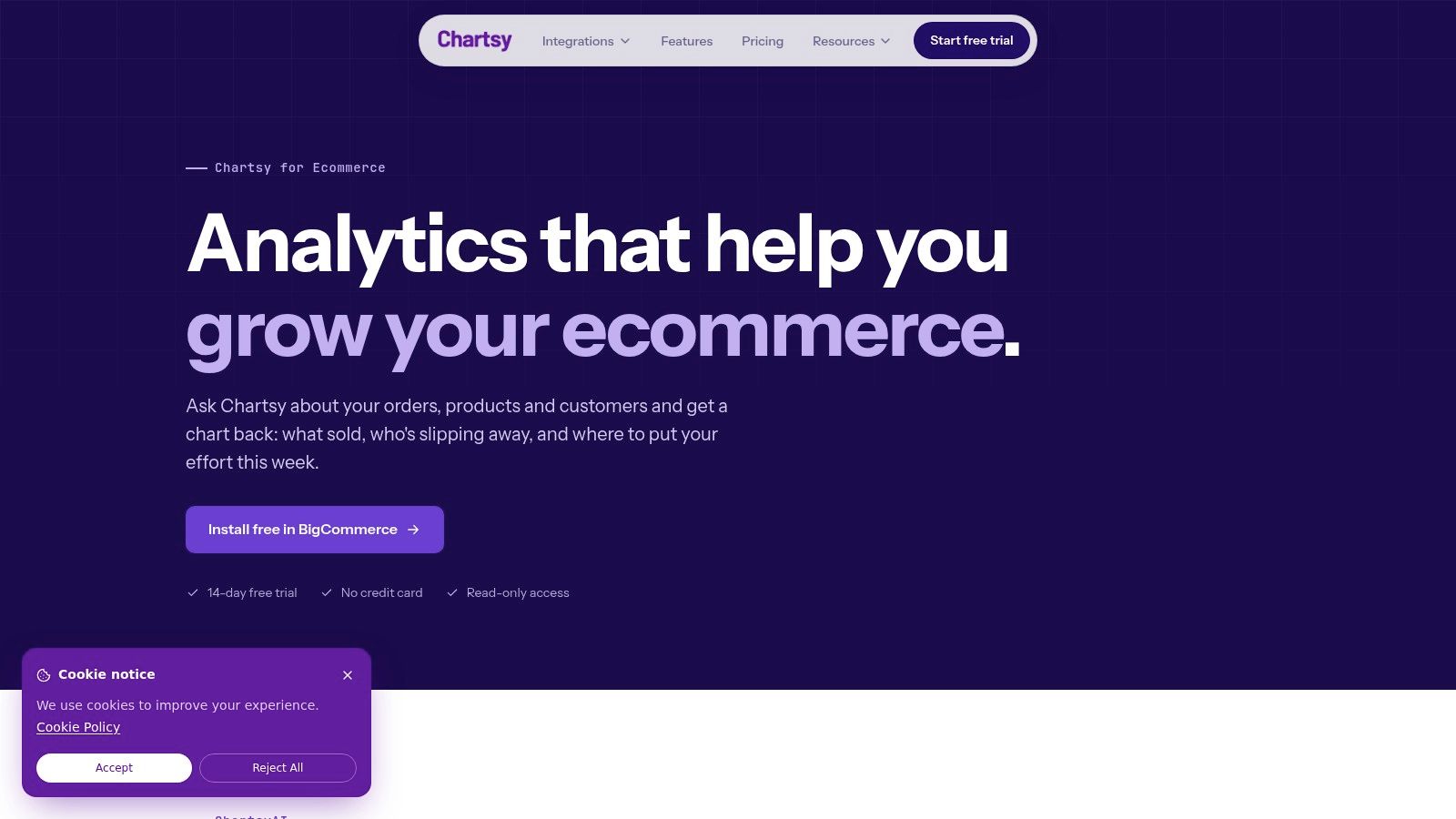
Dashboards cover 30+ ecommerce KPIs, with revenue and product performance at store, category, product and SKU level. Gross sales, discounts, refunds, shipping and tax are reported separately, so you can see exactly what sits between gross and net sales. When a dashboard doesn't answer your question, ask ChartsyAI for a custom report and save the chart to your dashboard. Queries are unlimited.
Where Chartsy fits best
Chartsy suits stores that want to understand sales, products and customers rather than ad spend. Every month it groups customers by purchase behaviour into Loyalists, Promising, At-Risk and Lost, which answers the "who stopped buying?" question Triple Whale doesn't focus on. Weekly or monthly email reports keep the team on the same numbers.
- Pros: Flat $19/month with 2 years of data history, which doesn't rise with GMV. 14-day free trial with no credit card, month-to-month billing, no storefront code, and PNG or PDF exports.
- Cons: No ad spend, ROAS or multi-touch attribution. It focuses on BigCommerce data, and the marketplace listing says it may not be fully compatible with multi-storefront stores.
If ads are a small part of your revenue, start here and pair it with GA4 for traffic.
2. Glew
Do you need store, customer and marketing data together, without attribution-first pricing? Glew for BigCommerce connects BigCommerce with other commerce and marketing sources and reports revenue, orders, AOV, visits and conversion rate alongside customer lifetime value and segments.
It overlaps with Triple Whale on channel reporting and goes deeper on customers. It is not a pixel-based attribution tool, so don't expect the same ad-level credit.
- Pros: Several sources in one view, prebuilt dashboards and segments, scheduled reports, and 16 reviews on the BigCommerce marketplace.
- Cons: Glew Pro is $250/month with annual prepayment, and Glew Plus is custom-priced. Setup is more involved than a single-store app.
A middle ground for multichannel stores. For a closer look, read Chartsy vs Glew.
3. Convertmax
If attribution really is the job, but you want it built for BigCommerce, look at Convertmax. It tracks visits, links orders to sessions, and reports attribution inside the BigCommerce admin, so marketers compare channels against completed orders rather than platform-reported conversions.
It is the closest like-for-like swap on this list for the attribution half of Triple Whale. It doesn't replace product, refund or customer reporting.
- Pros: Attribution tied to real BigCommerce orders, reporting inside the admin, and a flat listed price.
- Cons: The marketplace lists $249/month, which is steep for a small store. You still need another tool for SKU performance and net sales.
Worth it only when misattributed ad spend costs you more each month than the subscription.
4. PayHelm
What did you keep after discounts, tax and costs? PayHelm for BigCommerce combines product, customer, marketing, tax and accounting reporting, with automated syncing, exports and an AI agent for questions about store data.
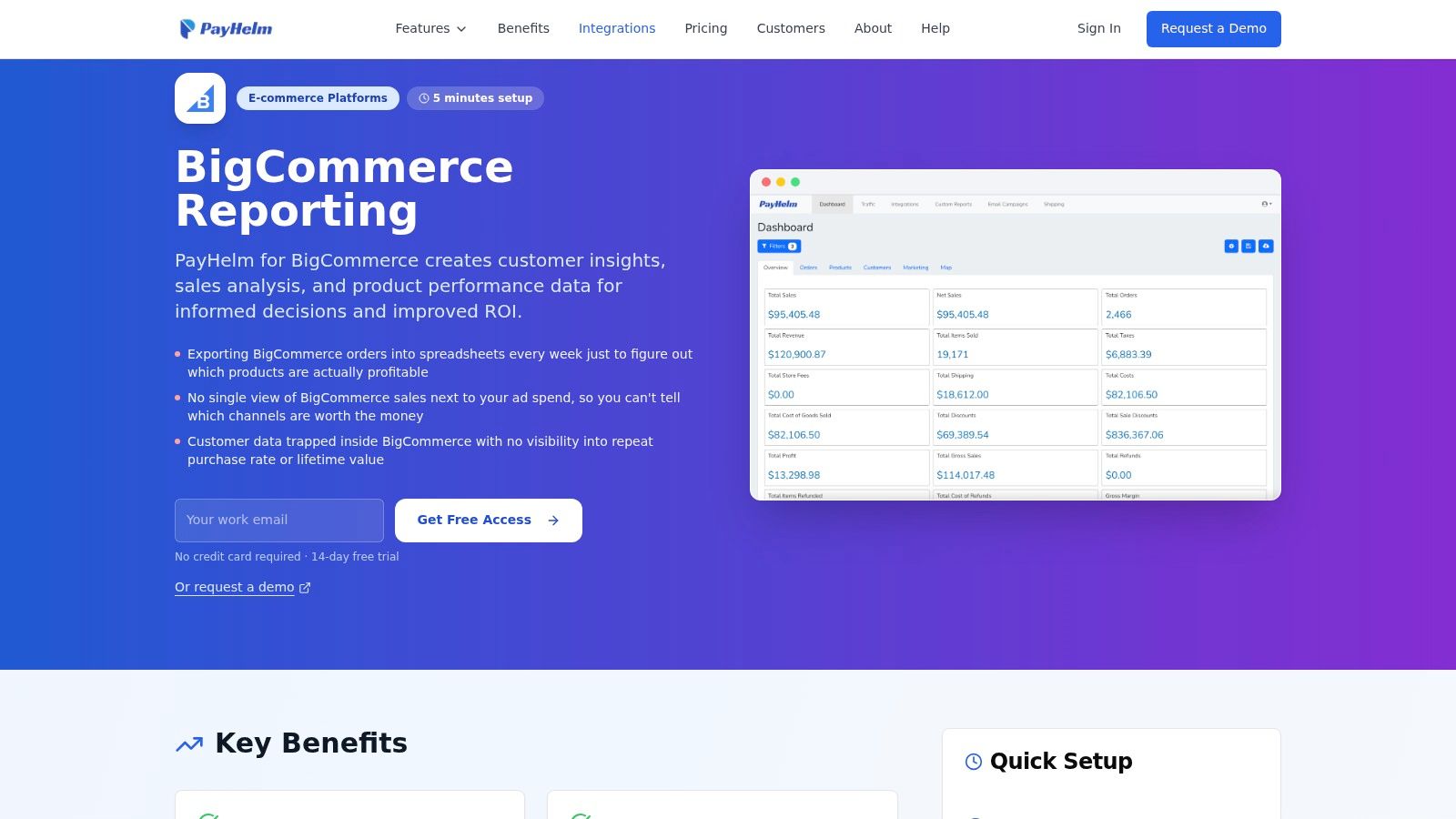
Marketing reports sit beside product and finance views, so you get some channel context without a separate attribution bill. Product reporting runs by SKU, variant and brand.
- Pros: Broad scope, compatible with multi-storefront on the listing, and 13 reviews praising filtering and setup.
- Cons: The marketplace lists $0/month, but attribution, traffic and some dashboards sit on paid plans or add-ons. The breadth can exceed a small store's needs.
Choose it when finance and tax reporting matter as much as marketing.
5. RetentionX
Want attribution and customer value in one place, for less than Triple Whale's paid tiers? RetentionX combines customer analytics, conversion tracking, attribution and automation, with LTV, cohort and RFM analysis.
Attribution plus retention
RetentionX goes beyond reporting with churn-risk signals and audience workflows that send segments to marketing channels. You don't just see that a group stopped buying; you can build an audience from it.
- Pros: Attribution, LTV and cohorts together, an action layer for win-back campaigns, and a listed starting price.
- Cons: Pricing is custom, starting at $49/month on the marketplace. The listing warns it may not be fully compatible with multi-storefront.
A good fit for stores with enough repeat buyers for cohorts to mean something.
6. Daasity
Is BigCommerce only part of your business, alongside Amazon, wholesale or retail? Daasity for BigCommerce is a data platform that brings sales, marketing and operations into one model, with 130+ prebuilt reports for BigCommerce merchants and marketing metrics such as CPA and CAC.
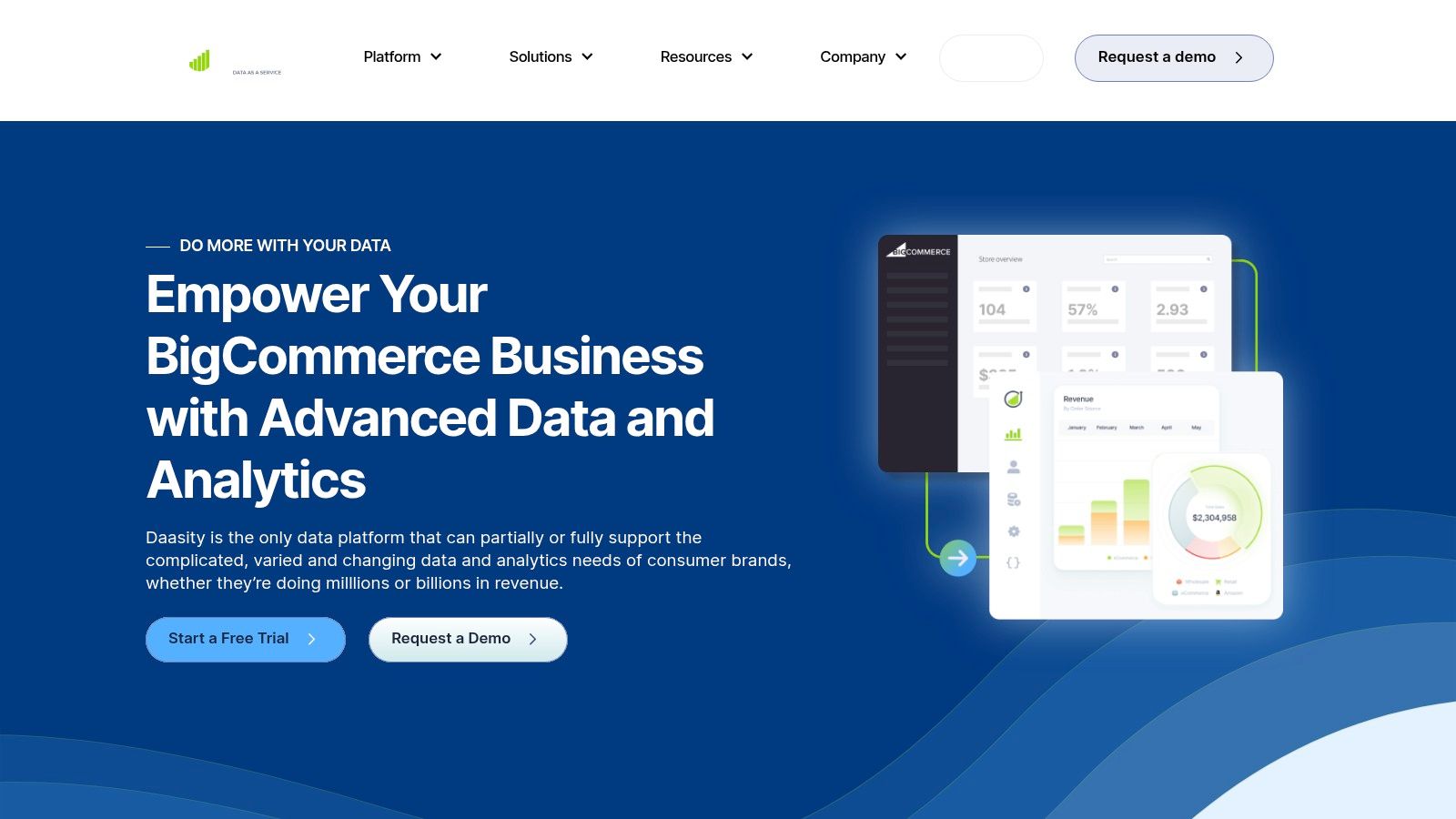
It replaces Triple Whale's reporting role at a larger scale, not its pixel.
- Pros: Cross-channel data, LTV and RFM analysis, and audience activation.
- Cons: PricingSaaS tracked its starting price rising from $399 to $1,899/month in 2026, plus usage charges. Implementation is a project.
For brands with a data team, not for a single store.
7. Sweet Analytics
What does a customer cost to acquire, and what do they return over time? Sweet Analytics answers that with lifetime value and acquisition-cost reporting, channel performance, attribution across online and offline touchpoints, and a single customer view.
- Pros: CAC and LTV side by side, online and offline activity combined, and integrations including Klaviyo, Recharge and Google Ads.
- Cons: The listing shows $99/month but was last updated in 2023, so verify current pricing and availability.
Treat it as a candidate to validate, not a default pick.
8. Putler
Running more than one store, or selling through PayPal and Stripe as well as BigCommerce? Putler combines several stores and payment sources into one dashboard, removes duplicates, and adds RFM segmentation, forecasting, 80/20 product analysis and weekly email reports.
It doesn't do ad attribution, so it is a store-reporting alternative rather than a like-for-like swap. Like Triple Whale, its price follows your revenue: Putler's pricing starts at $20/month up to $10K monthly revenue and reaches $2,250/month at $3M–$5M.
- Pros: Multi-store consolidation, unlimited team members, and a 14-day free trial with no credit card.
- Cons: Revenue-band pricing grows with the store, and there is no ad spend or attribution.
Pick it when the problem is several sources, not ads. See Putler alternatives for a closer comparison.
9. Google Analytics 4
Where did visitors come from, and which landing pages led to a purchase? Google Analytics answers the traffic and channel question for free. BigCommerce can send ecommerce events to GA4, and its attribution reports compare channels across the path to purchase.
GA4 doesn't know about refunds or a customer's full order history, so its revenue won't match your store's. Use it beside order data, never instead of it.
- Pros: Free, standard across the industry, and covers basic channel attribution.
- Cons: Session-based numbers, setup work for events, and no refund-aware net sales.
For many small stores, GA4 for traffic plus a store analytics app covers most of what they hoped Triple Whale would do.
10. BigCommerce multi-touch Attribution app
Need only channel credit, nothing else? The Attribution app on the BigCommerce marketplace describes first-touch, last-touch and multi-touch models that assign revenue to channels.
Practical rule: Clean up net sales before you split credit. Attribution on a muddy revenue number just spreads the mud.
- Pros: Narrow and focused, inside the BigCommerce ecosystem.
- Cons: No product mix, refunds or customer segments, and it only knows your ad spend if spend is part of the setup.
Add it after your store numbers are trustworthy, not before.
Triple Whale alternatives at a glance
Which question should the tool answer first: ad credit, customer value, or store performance? Compare by job, then check price.
| Tool | Best for | Starting price | Ad attribution |
|---|---|---|---|
| Chartsy | Store, product and customer analytics on BigCommerce | $19/month flat; 14-day free trial | No |
| Glew | Store and marketing data across several sources | $250/month (Pro, annual prepay) | Channel reporting |
| Convertmax | Attribution tied to BigCommerce orders | $249/month | Yes |
| PayHelm | Store, marketing, tax and accounting reporting | $0/month listed; paid tiers | On paid plans |
| RetentionX | Attribution plus LTV, cohorts and win-back audiences | Custom, from $49/month | Yes |
| Daasity | Multichannel brands with a data team | From $1,899/month reported, plus usage | Marketing metrics |
| Sweet Analytics | CAC and LTV with online and offline attribution | $99/month listed (2023) | Yes |
| Putler | Several stores and payment sources combined | $20/month, rising with revenue | No |
| Google Analytics 4 | Traffic and channel analysis | Free | Basic |
| BigCommerce Attribution app | Channel credit only | Check the listing | Yes |
| Triple Whale | Pixel-based attribution for ad-heavy brands | Free plan; Foundation from $219/month, priced by GMV | Yes |
Choosing the Right Fit for Your Store
Start with the share of revenue that comes from paid ads. If it's most of your revenue and your ad budget is large, attribution changes real decisions, and Triple Whale, Convertmax or RetentionX earn their price. If paid ads are a small slice, you are paying for a pixel to answer questions you don't ask.
Separate the two jobs before you buy anything.
- Ad credit: Convertmax, RetentionX, Sweet Analytics or the Attribution app, with GA4 as the free baseline.
- Store performance: Chartsy, PayHelm or Putler for net sales, products and customers.
- Everything in one model: Glew or Daasity, if you have several sources and someone to own the setup.
- Pricing shape: Triple Whale and Putler rise with revenue. Chartsy and Convertmax are flat.
Test with your own numbers. Pick the question your team asks most, such as "Which customers bought at least twice last year and haven't ordered in 90 days?", run it in a trial, and check the answer against an order export. Chartsy's 14-day trial, from $19/month with no credit card, is built for that kind of check.
If what you really need is a clear view of your BigCommerce sales, products and customers, you don't need an attribution platform priced on GMV. Chartsy connects in minutes, shows net sales down to the SKU, and tells you every month who your Loyalists are and who is slipping away. Start the trial and run one real question on your own store.

Written by
Chartsy TeamAnalytics team at Chartsy
The Chartsy Team writes guides, product updates, and resources to help SaaS and eCommerce founders make sense of their metrics, without SQL or spreadsheets.
Chartsy