Why are you leaving Putler? "The bill went up because we had a good month" is a pricing problem. "I need more than a sales summary for my BigCommerce store" is a depth problem. "We sell on five channels and need them modelled together" is a scale problem. Each one points to a different Putler alternative, so start by naming yours.
Know what Putler does well. Putler for BigCommerce consolidates multiple stores, payment gateways and Google Analytics into one dashboard. It cleans up duplicates and converts currencies, and adds RFM segmentation, forecasting, 80/20 product analysis, "frequently bought together" insights and weekly email reports. Team members are unlimited. For a merchant juggling several stores and PayPal or Stripe, that's useful.
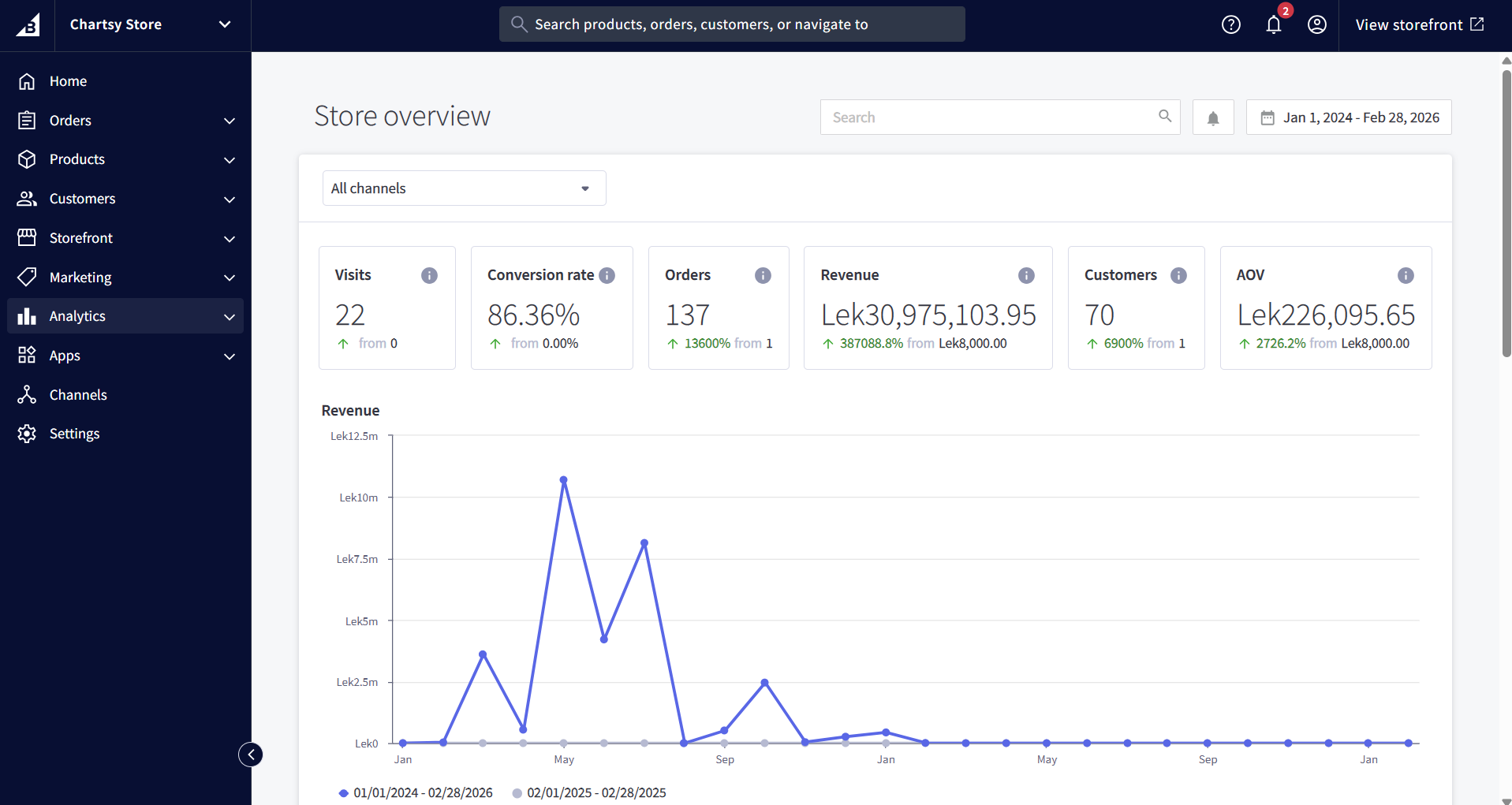
The catch is the pricing model. Putler's pricing page meters monthly revenue and moves you between bands automatically. It's $20/month up to $10K in monthly revenue, $150 at $50K–$100K, $500 at $300K–$500K, and $2,250 at $3M–$5M. Growth costs you more every time you cross a band. If you're comparing monthly figures, keep the KPIs that actually matter for BigCommerce growth in front of you, so you're judging tools on the questions you ask, not on chart count.
Table of Contents
- 1. Chartsy
- 2. PayHelm
- 3. Glew
- 4. RetentionX
- 5. Zoho Analytics
- 6. SyncRange
- 7. Google Analytics 4
- 8. BigCommerce Analytics and Insights
- Putler alternatives at a glance
- Choosing the Right Fit for Your Store
1. Chartsy
What if the price stayed the same when your revenue doubled? Chartsy for BigCommerce charges by how much data history you keep, not by how much you sell. It's $19/month for 2 years of history, and each extra year adds $5/month. A store doing $20K a month and one doing $2M a month pay the same.
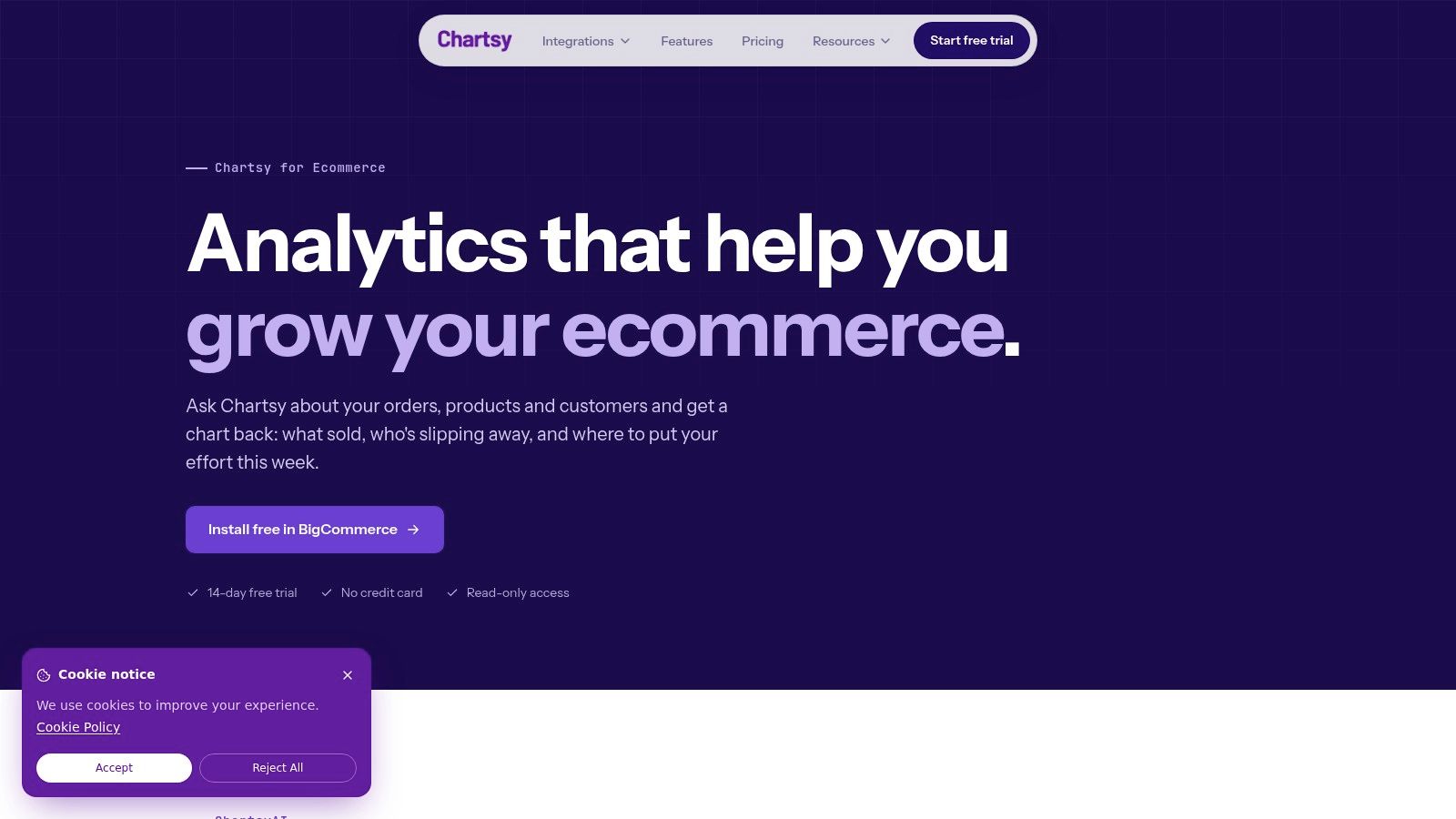
Install it from the BigCommerce marketplace and your last 12 months of orders sync straight away. Dashboards cover 30+ ecommerce KPIs, with revenue and product performance at store, category, product and SKU level. Gross sales, discounts, refunds, shipping and tax are reported separately, so net sales are never a guess.
Where Chartsy fits best
Chartsy matches Putler's customer segmentation and goes further on custom reporting. Every month it groups customers into Loyalists, Promising, At-Risk and Lost. When you need a cut that isn't on a dashboard, ask ChartsyAI for a custom report and save it to your dashboard. Queries are unlimited, and weekly or monthly email reports keep the team informed.
- Pros: Flat pricing that doesn't follow revenue, a 14-day free trial with no credit card, month-to-month billing, read-only API access, and PNG or PDF exports.
- Cons: It covers BigCommerce data only, so it won't merge PayPal, Stripe or a second platform the way Putler does. The listing says it may not be fully compatible with multi-storefront stores.
The best swap when BigCommerce is your main store and Putler's revenue bands keep pushing your bill up.
2. PayHelm
Do you need tax and accounting views next to sales? PayHelm for BigCommerce combines product, customer, marketing, tax and accounting reporting, with exports to CSV or Google Sheets and an AI agent for store questions.
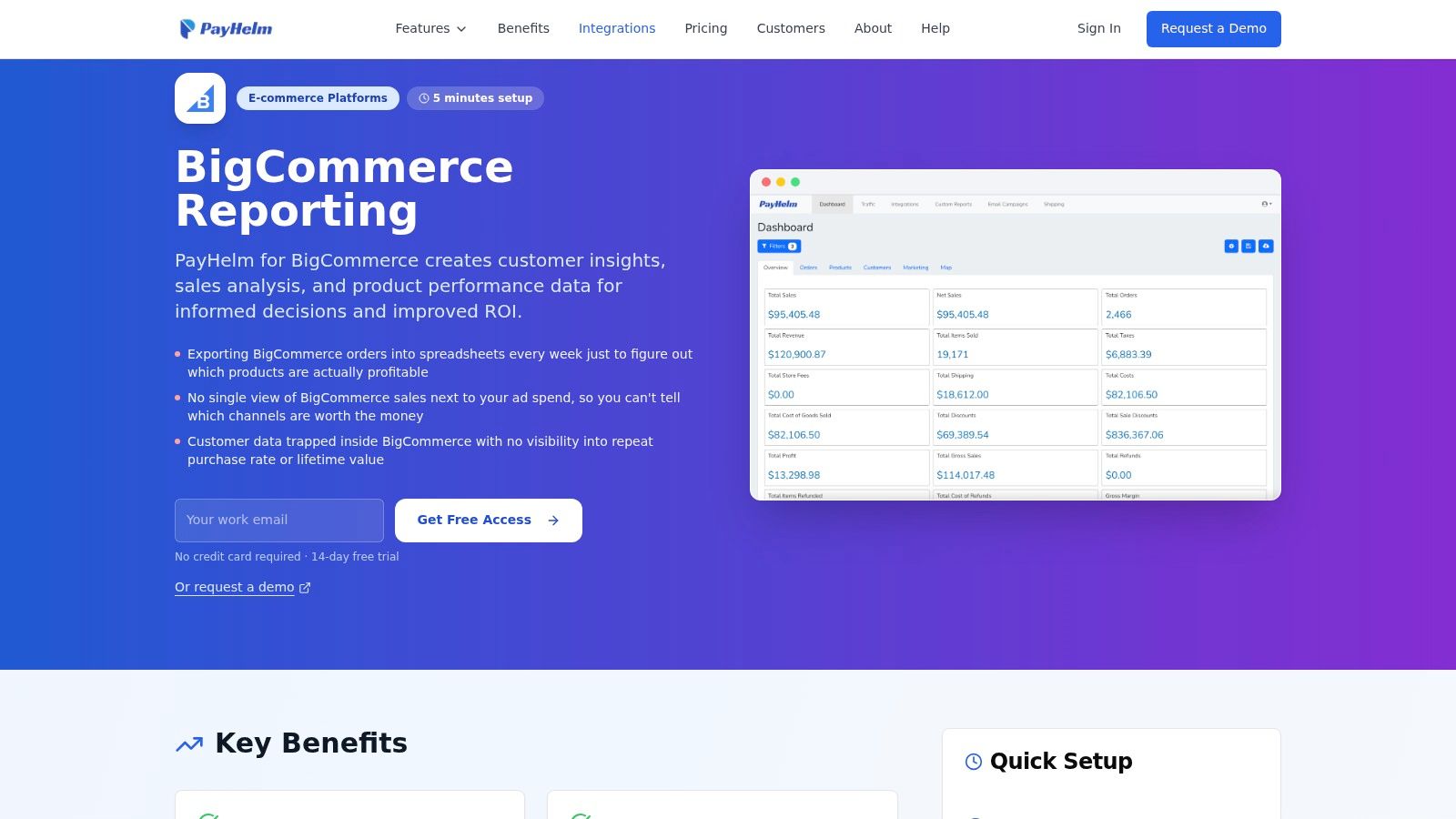
It covers the finance side that Putler's sales dashboards leave thin. Product reporting runs by SKU, variant and brand.
- Pros: $0/month entry on the marketplace, compatible with multi-storefront, and 13 reviews.
- Cons: Some dashboards, attribution and traffic reports sit on paid plans or add-ons. The breadth can be more than a small store needs.
A good choice when your accountant is one of the people reading the reports.
3. Glew
Is multi-source consolidation the reason you chose Putler? Glew for BigCommerce connects BigCommerce with other commerce, marketing and sales sources, then reports revenue, orders, AOV, visits and conversion rate with customer lifetime value and segments.
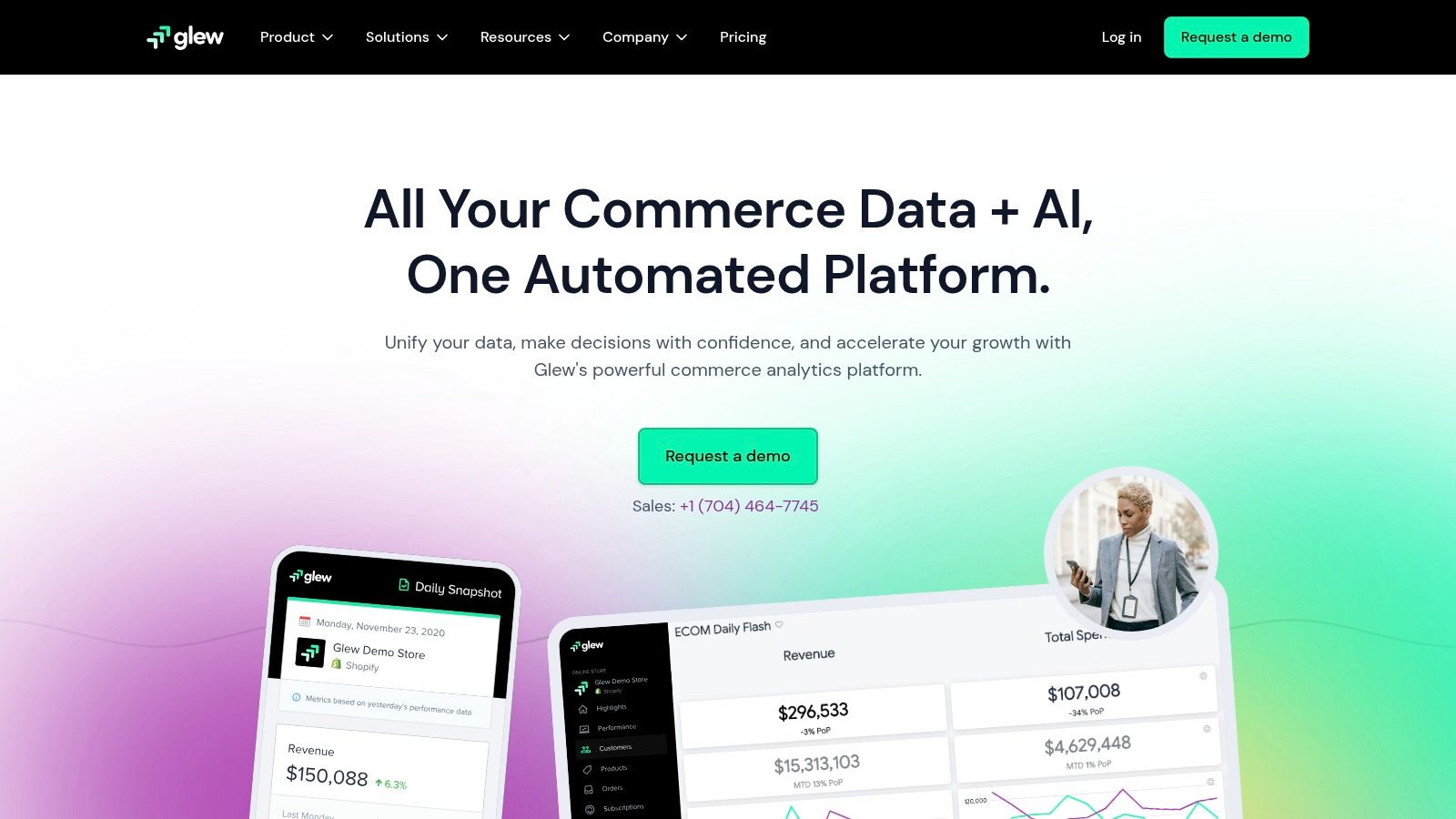
It goes deeper on marketing than Putler, at a fixed plan price rather than a revenue band.
- Pros: Several sources in one view, scheduled reports, and 16 reviews on the marketplace.
- Cons: Glew Pro is $250/month with annual prepayment, and advanced custom reporting is custom-priced. Setup takes longer.
The right step up when you've outgrown a sales summary across channels. See Chartsy vs Glew as well.
4. RetentionX
Did you rely on Putler's RFM segments most? RetentionX puts retention at the centre, with LTV, cohort and RFM analysis, churn-risk signals, attribution, and audience workflows that send segments to marketing tools.
- Pros: Segments you can act on, not just view, and attribution in the same tool.
- Cons: Custom pricing from $49/month, and the listing warns it may not be fully compatible with multi-storefront.
Worth it when you run win-back campaigns every month.
5. Zoho Analytics
Want to blend BigCommerce with the rest of the business? Zoho Analytics for BigCommerce is a full BI tool with a BigCommerce connector, prebuilt reports and custom dashboards.
The connector is included with paid Zoho Analytics accounts, with a 15-day connector trial, and sync frequency depends on your plan.
- Pros: Flexible dashboards and cross-source analysis, with a price that doesn't follow your revenue.
- Cons: More setup than Putler, and someone needs to own the definitions.
Choose it if you already use Zoho apps or want room to grow into BI.
6. SyncRange
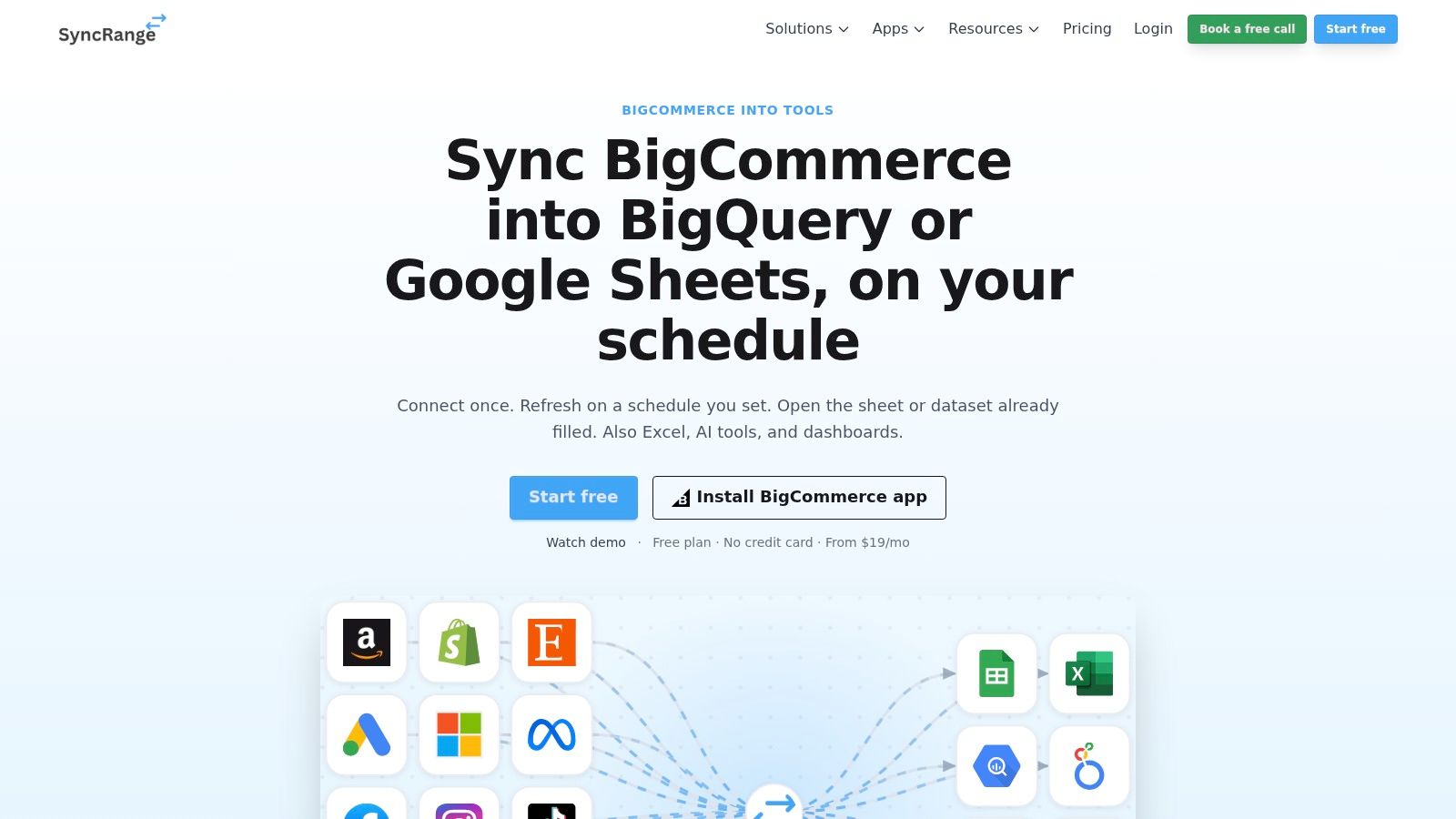
Do you mostly use Putler's CSV exports? SyncRange for BigCommerce automates that step, sending orders, line items, customers, products, categories, brands and coupons to Google Sheets, Excel or BigQuery on a schedule.
- Pros: No more manual downloads, line-item detail, and full control over your own reports.
- Cons: You build and maintain every chart. $19/month on the marketplace, with a free starting option mentioned on SyncRange's site.
Ideal when your reports already live in a spreadsheet and you only need fresh data.
7. Google Analytics 4
Putler pulls in Google Analytics, so you may be relying on it for traffic. Google Analytics is free and remains the standard for sessions, sources and conversion paths. BigCommerce can send ecommerce events to it directly.
Practical rule: A session report and an order report answer different questions. Their totals won't match, and that isn't a broken export.
- Pros: Free, with traffic and channel data no store app replaces.
- Cons: Doesn't know refunds or full order history, and needs correct event setup.
Keep it beside whichever store tool you choose.
8. BigCommerce Analytics and Insights
Have you checked what's already in your admin? Native BigCommerce Analytics covers merchandising, orders, customers, marketing and tax. The Ecommerce Analytics guide lists 11 report types, most updating in less than 60 seconds.
Know what you already pay for
BigCommerce Insights adds repeat-purchase, cohort and product analysis on top. The Tooltester BigCommerce review reports Insights starting at $49/month.
- Pros: No extra vendor, and the data is already there.
- Cons: Fixed columns, one store only, and saved custom views are limited. Read where built-in analytics run out.
Measure every paid app against this baseline first.
Putler alternatives at a glance
Does the price follow your revenue, and does the tool cover more than one source? Those two columns usually decide it.
| Tool | Best for | Starting price | Price rises with revenue | Multi-source |
|---|---|---|---|---|
| Chartsy | BigCommerce sales, product and customer analytics | $19/month; 14-day free trial | No | BigCommerce only |
| PayHelm | Store, tax and accounting reporting | $0/month listed; paid tiers | Plan-dependent | Yes |
| Glew | Several commerce and marketing sources | $250/month (Pro, annual prepay) | Plan-dependent | Yes |
| RetentionX | Retention, cohorts and win-back audiences | Custom, from $49/month | Custom | Yes |
| Zoho Analytics | BI across store and business data | Paid Zoho plan | No | Yes |
| SyncRange | Scheduled exports to Sheets, Excel or BigQuery | $19/month listed | Volume-dependent | Destinations only |
| Google Analytics 4 | Traffic and channels | Free | No | Web data |
| BigCommerce Insights | Built-in cohort and repeat-purchase reports | From $49/month reported | No | BigCommerce only |
| Putler | Several stores and payment sources combined | $20/month up to $10K monthly revenue | Yes | Yes |
Choosing the Right Fit for Your Store
Go back to the reason you're leaving. If it's price, work out what Putler would cost at the revenue you expect next year, then compare it with a flat-priced tool. If it's depth, test whether the alternative answers the question Putler couldn't. If it's scale, you need a tool that models several channels, not just one that displays them.
- Pricing that follows revenue: Chartsy, Zoho Analytics or native Insights keep the bill flat.
- More depth on one BigCommerce store: Chartsy or PayHelm.
- Several stores and channels: Glew, or keep Putler for consolidation.
- Retention campaigns: RetentionX.
- Your own spreadsheets: SyncRange.
Test with one real question, such as "Which customers were Loyalists last quarter and are At-Risk now?" Run it in a trial and check it against an order export. Chartsy's 14-day trial, from $19/month with no credit card, gives you enough time to compare it side by side with Putler on the same store.
If your BigCommerce store is growing, your analytics bill shouldn't grow with it. Chartsy gives you net sales down to the SKU, monthly customer segments and custom reports for a flat $19/month, however much you sell. Start the trial and compare it with Putler on your own numbers.

Written by
Chartsy TeamAnalytics team at Chartsy
The Chartsy Team writes guides, product updates, and resources to help SaaS and eCommerce founders make sense of their metrics, without SQL or spreadsheets.
Chartsy