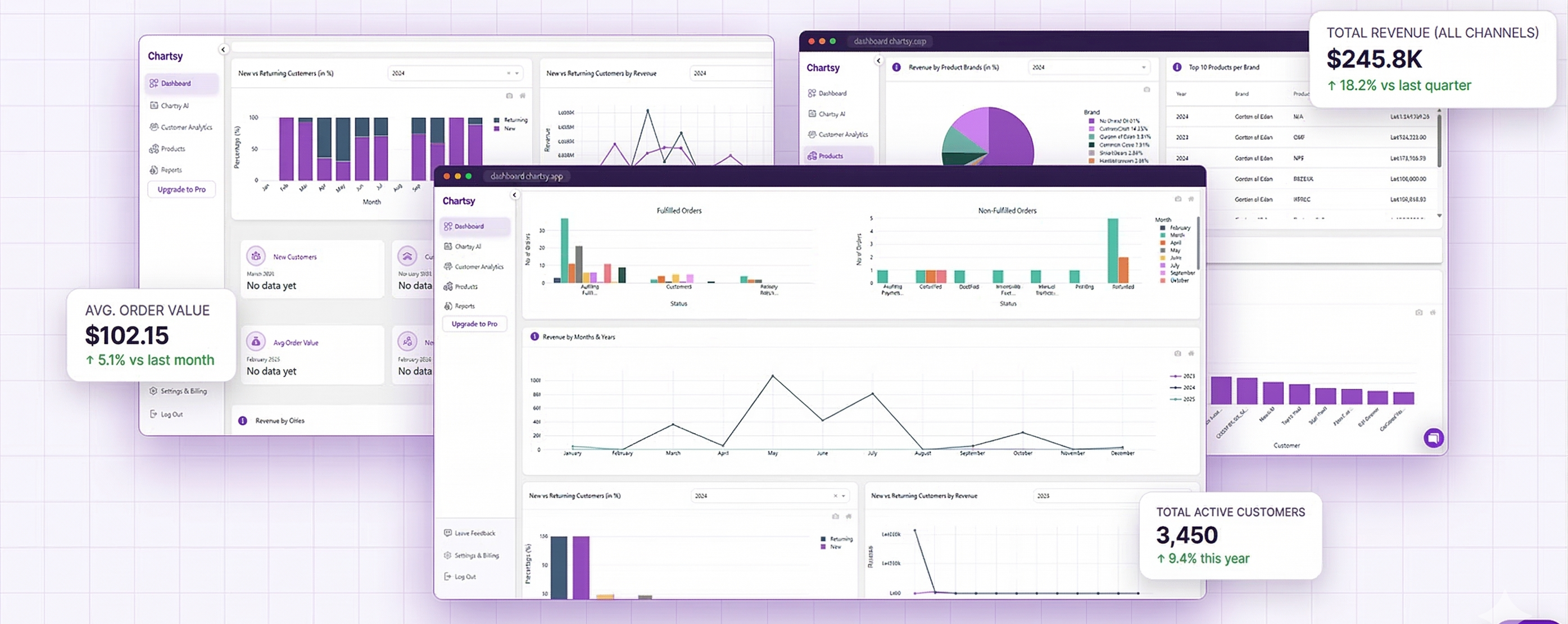
Do you need a data platform, or do you need answers? "How do Amazon, wholesale and BigCommerce sales add up by SKU this quarter?" is a data-platform question. "Which products did our best customers buy first?" and "What were net sales by category last month, after refunds?" are store questions. Daasity is built for the first kind. Many BigCommerce merchants looking for a Daasity alternative only need the second.
Know what Daasity does well. Daasity for BigCommerce calls itself an ELT+ platform for retail brands. It extracts sales, marketing and operations data, models it, and serves 130+ prebuilt reports for BigCommerce merchants, plus LTV, RFM, CAC and inventory analysis and audience activation. That is real depth for a brand selling on several channels with an analyst to run it.
The price reflects it. Daasity's BigCommerce marketplace listing once showed $349/month, but PricingSaaS tracked its starting price rising from $399 to $1,899/month in 2026, with usage charges based on rolling revenue on top. Its support docs place the BigCommerce integration on the Pro tier. For a single BigCommerce store, that is a lot of platform. The guide to why BigCommerce's built-in analytics aren't enough helps you see where native reports stop and paid tools start.
Table of Contents
- 1. Chartsy
- 2. Glew
- 3. PayHelm
- 4. Zoho Analytics
- 5. SyncRange
- 6. Google BigQuery
- 7. Google Looker Studio
- 8. Microsoft Power BI
- 9. Putler
- 10. RetentionX
- Daasity alternatives at a glance
- App, Warehouse or Hybrid: Picking Your Route
1. Chartsy
What if the reports Daasity would build for you were ready the day you install? Chartsy for BigCommerce connects from the BigCommerce marketplace in minutes, syncs your last 12 months of orders straight away, and needs no warehouse, no data model and no analyst.
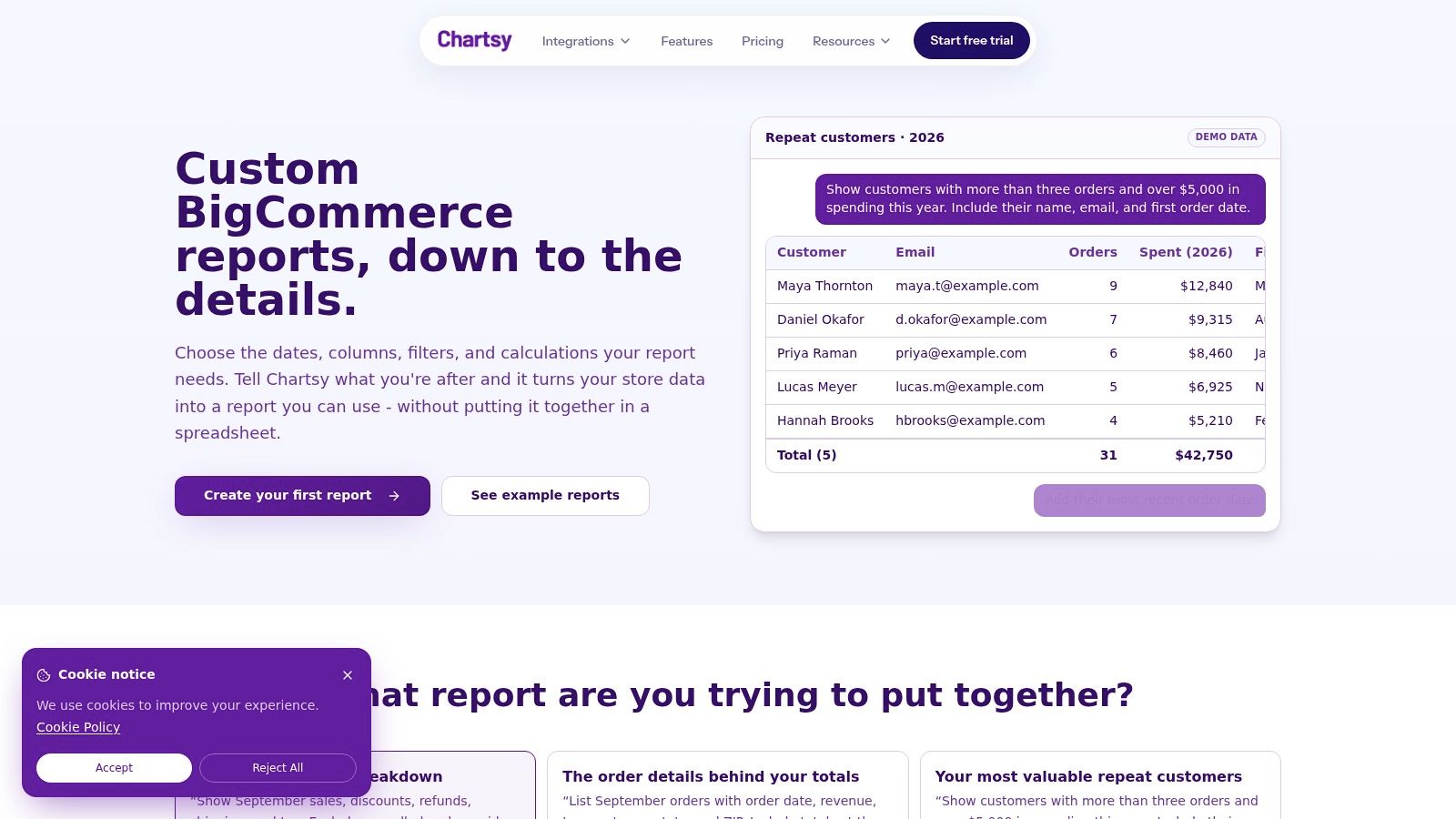
Dashboards cover 30+ ecommerce KPIs, with revenue and product performance at store, category, product and SKU level. Gross sales, discounts, refunds, shipping and tax are reported separately, so net sales are clear. When you need a cut that isn't on a dashboard, ask ChartsyAI for a custom report and save it. Queries are unlimited.
Where Chartsy fits best
Chartsy covers the customer side Daasity is known for, without the build. Every month it groups customers by purchase behaviour into Loyalists, Promising, At-Risk and Lost, and customer lifetime value comes straight from order history. Weekly or monthly email reports replace the Monday export.
- Pros: $19/month with 2 years of history, and each extra year adds $5/month. 14-day free trial with no credit card, month-to-month, read-only API access, and PNG or PDF exports.
- Cons: It covers BigCommerce data only, so it won't merge Amazon, wholesale or ad spend. The listing says it may not be fully compatible with multi-storefront stores.
The right pick when BigCommerce is your main channel and nobody on the team wants to maintain a data model.
2. Glew
Need several sources combined, but as an app rather than a warehouse project? Glew for BigCommerce connects BigCommerce with other commerce and marketing sources and reports revenue, orders, AOV, visits and conversion rate alongside customer lifetime value and segments.
It is the closest ready-made alternative to Daasity's multi-source view, at a much lower entry price.
- Pros: Multiple sources, prebuilt dashboards, scheduled reports, and 16 reviews on the marketplace.
- Cons: Glew Pro is $250/month with annual prepayment, and Glew Plus with advanced custom reporting is custom-priced.
Choose it when fragmentation is the problem but you don't want to own a warehouse. See Chartsy vs Glew for a direct comparison.
3. PayHelm
Does finance need the numbers as much as marketing? PayHelm for BigCommerce combines product, customer, marketing, tax and accounting reporting, with automated syncing, exports to CSV or Google Sheets, and an AI agent for store questions.
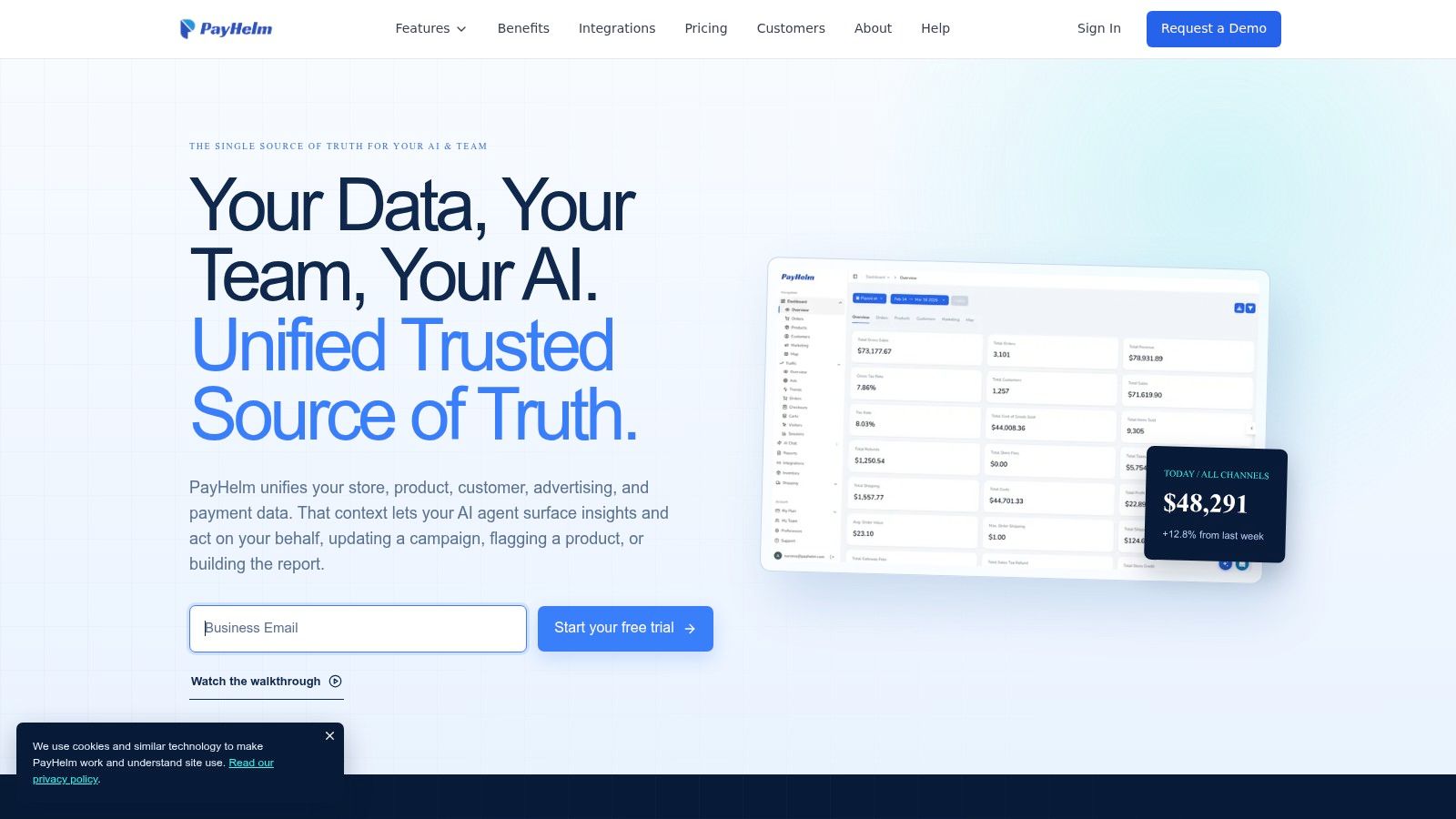
Product reporting runs by SKU, variant and brand. Profit views are only as good as the cost data you load.
- Pros: Broad reporting with finance views, compatible with multi-storefront on the listing, and 13 reviews.
- Cons: $0/month on the listing, but some dashboards and marketing features sit on paid plans or add-ons.
A practical swap when the Daasity use case was really reconciliation with accounting.
4. Zoho Analytics
Want a BI tool you can grow into, without a separate warehouse? Zoho Analytics for BigCommerce has a BigCommerce connector, prebuilt reports and custom dashboards, and you can blend store data with other business data as questions get harder.
Custom dashboards need someone who owns the definitions. Decide early whether net sales includes tax and shipping, and write it down.
Cost and refresh trade-offs
The connector is included with paid Zoho Analytics accounts, with a 15-day connector trial. Sync frequency depends on your plan, so check it against how often you read the reports.
- Pros: A path from prebuilt ecommerce reports to full BI, and cross-source analysis.
- Cons: Needs a paid plan, refresh depends on it, and the build effort is real.
The best fit if you want Daasity-style flexibility at a lower cost and have someone comfortable with BI.
5. SyncRange
Is the real job "get BigCommerce data out on a schedule"? SyncRange for BigCommerce exports orders, order line items, customers, products, categories, brands and coupons to Google Sheets, Excel or BigQuery on a schedule.
That covers the extract step of Daasity's ELT. You still build the model and the reports yourself.
- Pros: No repeated manual downloads, line-item detail, and a warehouse destination.
- Cons: You maintain every formula and chart. The marketplace shows $19/month, while SyncRange's site mentions a free starting option, so confirm the limits for your volume.
Pair it with one of the next three tools for a budget build-your-own stack.
6. Google BigQuery
BigQuery is the warehouse many Daasity-style stacks sit on. Load BigCommerce orders next to ad, finance or marketplace extracts, then query them with SQL or a BI tool.
Practical rule: A warehouse pays off when the same cleaned orders feed five reports. It doesn't pay off for one monthly SKU table.
- Pros: Full control, any source you can load, and usage-based pricing that starts low.
- Cons: Someone must own the schema, the loading jobs and the definitions. That person is the real cost.
Choose it only if you have, or plan to hire, someone who writes SQL.
7. Google Looker Studio
Need shareable dashboards on top of the data you've already exported? Looker Studio is a free reporting canvas that reads from BigQuery, Google Sheets and other sources.
- Pros: No licence fee, easy sharing, and familiar to most marketers.
- Cons: It is only a canvas. Field changes in your data can break charts, and someone has to fix them.
For a walkthrough, see how to build a BigCommerce dashboard without hiring a developer.
8. Microsoft Power BI
Does the company already run on Microsoft? Power BI is the familiar home for a commerce model there. Land BigCommerce orders in a database or warehouse first, then build measures for net sales, refund rate and LTV.
- Pros: Finance and operations data alongside order lines, and scheduled report packs.
- Cons: No ready-made BigCommerce connector in the box, and data prep is the real work.
A good fit for teams that already have a Power BI author.
9. Putler
Running several stores or payment sources? Putler consolidates multiple BigCommerce stores, PayPal, Stripe and Google Analytics into one dashboard, with RFM segmentation, forecasting, 80/20 product analysis and CSV exports.
It handles multi-source consolidation, a big part of why brands buy Daasity, without a warehouse.
- Pros: Multi-store view, unlimited team members, and a 14-day free trial with no credit card.
- Cons: Revenue-band pricing from $20/month that rises to $2,250/month at $3M–$5M monthly revenue. No marketplace or wholesale modelling.
A lighter route to one combined view. See the Putler alternatives guide for more.
10. RetentionX
Was LTV and retention the reason you looked at Daasity? RetentionX focuses there, with LTV, cohort and RFM analysis, churn-risk signals, attribution, and audiences you can send to marketing tools.
- Pros: Retention analysis and activation together, at a fraction of Daasity's price.
- Cons: Custom pricing from $49/month, and the listing warns it may not be fully compatible with multi-storefront.
Choose it when customer value matters more than cross-channel modelling.
Daasity alternatives at a glance
Ready-made app, warehouse stack, or something in between? Compare setup effort as well as price.
| Tool | Best for | Starting price | Setup effort |
|---|---|---|---|
| Chartsy | BigCommerce sales, product and customer analytics | $19/month; 14-day free trial | Low; connect in minutes |
| Glew | Several commerce and marketing sources in one app | $250/month (Pro, annual prepay) | Moderate |
| PayHelm | Store, marketing, tax and accounting reporting | $0/month listed; paid tiers | Low to moderate |
| Zoho Analytics | Growing into BI with store and business data | Paid Zoho plan | Moderate to high |
| SyncRange | Scheduled exports to Sheets, Excel or BigQuery | $19/month listed | Moderate; you build reports |
| Google BigQuery | Custom warehouse for several data sources | Usage-based | High |
| Google Looker Studio | Shareable dashboards on exported data | Free | Moderate |
| Microsoft Power BI | Microsoft-based BI teams | Free and paid plans | High |
| Putler | Several stores and payment sources combined | $20/month, rising with revenue | Low |
| RetentionX | LTV, cohorts and win-back audiences | Custom, from $49/month | Moderate |
| Daasity | Multichannel brands with a data team | From $1,899/month reported, plus usage | High |
App, Warehouse or Hybrid: Picking Your Route
Count your sources first. If BigCommerce is most of your revenue, a ready-made app answers nearly every question Daasity would, at a small share of the cost. If you sell heavily on Amazon, wholesale or in retail too, you need consolidation, and the choice is between an app like Glew or a warehouse you own.
Then count your people. A warehouse stack is cheap in licences and expensive in hours. Ask who will fix the dashboard when a field changes, and if the answer is nobody, choose an app.
- One store, no analyst: Chartsy, PayHelm or Putler.
- Several sources, no analyst: Glew or Putler.
- Several sources, an analyst: SyncRange plus BigQuery with Looker Studio or Power BI, or Zoho Analytics.
- Retention is the priority: RetentionX or Chartsy's monthly segments.
Run a real test before you commit. Take one question your team asks every month, such as "What were net sales by category last month, after discounts and refunds?", answer it in a trial, and check it against an order export. Chartsy's 14-day trial, from $19/month with no credit card, lets you do that on your own store in an afternoon.
If you went looking at Daasity because spreadsheets stopped scaling, you may not need a data platform at all. Chartsy gives BigCommerce stores net sales down to the SKU, monthly customer segments and custom reports from day one, with no warehouse and no setup project. Start the trial and see your own numbers today.

Written by
Chartsy TeamAnalytics team at Chartsy
The Chartsy Team writes guides, product updates, and resources to help SaaS and eCommerce founders make sense of their metrics, without SQL or spreadsheets.
Chartsy